Article · Military watches · 1860–1997
Watches that glowed in the dark water
In the late 1930s, Italian naval divers prepared to ride underwater vehicles into enemy harbors at night. They needed watches they could read in black water. A family firm from Florence made them, and created one of the most distinctive watch designs of the century.
A shop on the bridge
In 1860, Giovanni Panerai opened a watchmaker’s shop on the Ponte alle Grazie in Florence. It was a modest business that sold and repaired watches and also served as the city’s first watchmaking school. Over the following decades, under Giovanni’s son and grandson, the firm grew and developed a specialty that would define it: precision instruments for the Italian Royal Navy, the Regia Marina.
The Panerai workshop made depth gauges, compasses, torches, detonators and other devices for naval use. Its close relationship with the Navy gave it insight into the needs of sailors and divers. It was a relationship based on secrecy: many of Panerai’s products were classified, and the company’s work for the Navy remained little known to the public for decades.
Radiomir
In 1916, Guido Panerai, the founder’s grandson, patented a luminous paint based on radium, which he called Radiomir. It was intended for military instruments that needed to be read in the dark, such as sights and compasses. Like other radium paints of the time, it glowed brightly and continuously. Its dangers to health were not yet fully understood.
A watch for divers
In the 1930s, the Italian Navy was developing a new kind of warfare. Its engineers had designed a slow-moving underwater vehicle, the siluro a lenta corsa or slow-running torpedo, ridden by two divers sitting astride it. The divers would steer it into an enemy harbor at night, detach its explosive warhead under the hull of a ship and escape. The operators nicknamed it the maiale, or pig, because it was difficult to handle.
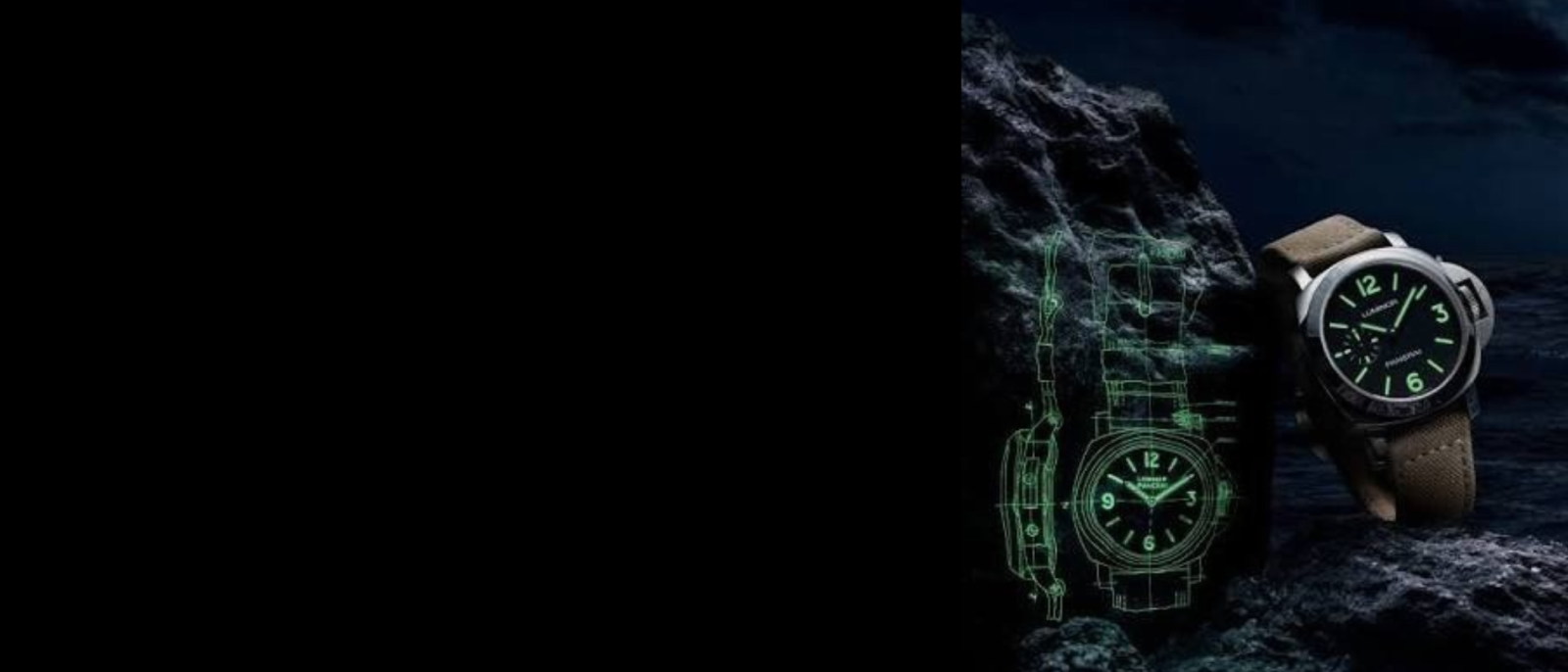
These divers needed a watch that could be read in the darkness underwater, that would survive long immersion and that was robust enough for military use. In 1936, Panerai made a prototype watch for the Navy’s submarine group command. It was large, with a cushion-shaped case and a dial with huge luminous numerals and markers painted with Radiomir. It would become the model for all later Panerai watches.