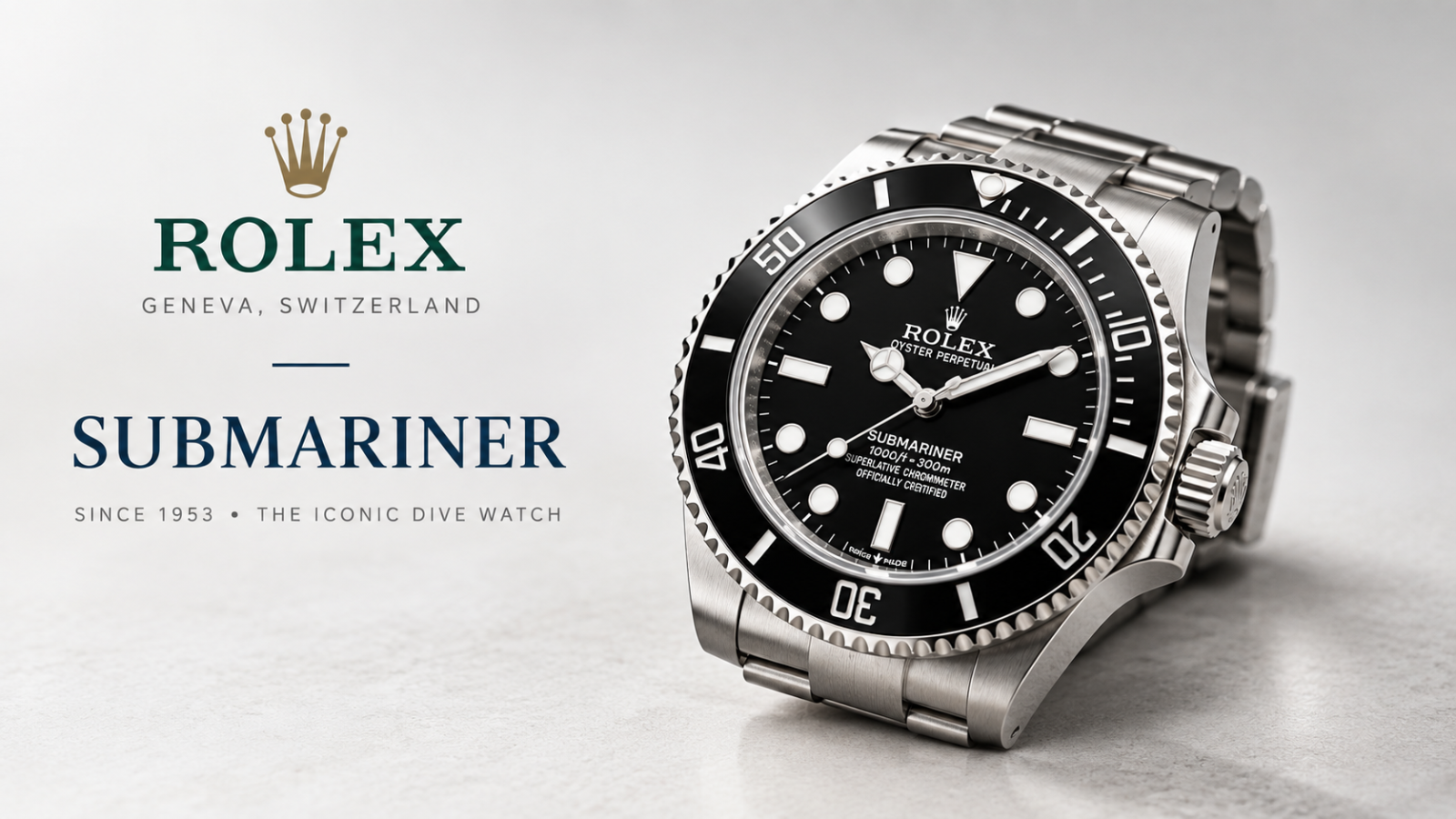
Brand · Geneva, Switzerland
Rolex
Born in London and raised in Geneva, the brand turned the wristwatch into something tough, precise and recognizable from across the room.
Rolex began in London in 1905 under the name Wilsdorf & Davis. The German-born Hans Wilsdorf and his brother-in-law Alfred Davis imported Swiss movements and fitted them into English cases.
The Rolex name was registered in 1908. Wilsdorf wanted a short word that was easy to say in any language and small enough to fit on a dial.
The watch that kept the water out
In the 1920s, wristwatches were still seen as fragile. Dust and moisture crept in through the crown and the caseback. In 1926 Rolex patented the Oyster case, with a screw-down caseback, bezel and crown that sealed the movement like an oyster.
To prove it, Wilsdorf gave an Oyster to the swimmer Mercedes Gleitze, who crossed the English Channel in 1927 with the watch on her wrist.
Winding without the crown
In 1931 came the Perpetual rotor: a half-moon weight that spins freely as the arm moves and winds the watch. It is the basis of almost every automatic watch made since.
Tool watches
In the 1950s, Rolex built watches for specific jobs: the Submariner for divers, the GMT-Master for pilots and the Explorer for mountaineers. In 1946 Wilsdorf had also founded Tudor, to offer the same toughness at a lower price.
Who owns it
Wilsdorf had no children. Before his death in 1960 he left his shares to the foundation that bears his name. That is why Rolex is not listed on any stock exchange and does not publish production figures.
Timeline
- 1905Wilsdorf & Davis
Founded in London.
- 1926Oyster
Sealed case patented.
- 1945Datejust
Date in a window, changing at midnight.
- 1953Submariner
The brand's dive watch is born.
- 1963Daytona
A chronograph for motor racing.
- 2012Mariana Trench
An experimental watch dives nearly 11,000 meters.