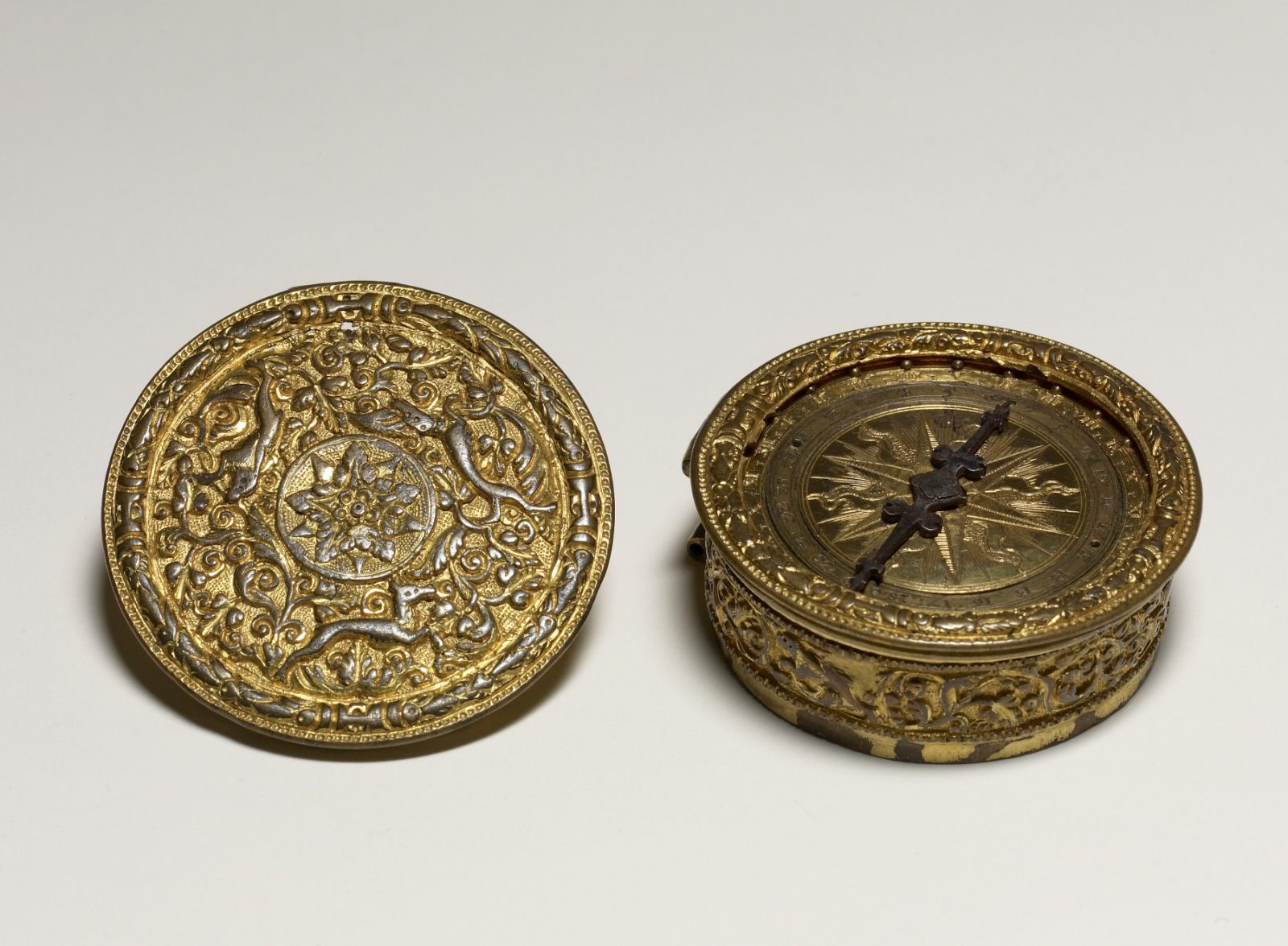
Article · The birth of the watch · c. 1500
A clock you could carry
Around the year 1500, the craftsmen of a prosperous German trading city found a way to make a clock small enough to hang from a chain. It was crude, it had one hand and it was rarely right, but it changed how people related to time.
Time belonged to the tower
For most of the Middle Ages, mechanical time was something you heard rather than something you owned. From the late thirteenth century onward, the cities of Europe raised great iron clocks in church towers and town halls. They were driven by heavy stone or lead weights hanging from ropes, regulated by a swinging bar called a foliot, and they announced the hours with bells. A merchant in Florence or a weaver in Ghent organized the day around those bells. The time was public, communal and fixed in one place.
A weight-driven clock cannot travel. The weight must fall freely, the frame must stand perfectly still, and the whole machine is usually larger than a wardrobe. To make a clock that could be carried, someone first had to replace the falling weight with a different source of power.
The coiled spring
That source was the mainspring: a long ribbon of hammered steel, wound tightly into a drum, releasing its energy slowly as it uncoiled. Nobody knows who first used one in a clock. Spring-driven clocks were being made in the first half of the fifteenth century, and a chamber clock associated with the court of Burgundy, dated to around 1430, is often cited as the oldest surviving example.
A spring brought a new problem with it. When fully wound it pushes hard, and as it runs down it pushes weakly, so a clock driven directly by a spring runs fast in the morning and slow by evening. Two answers appeared. One was the fusee, a cone-shaped pulley linked to the spring barrel by a chain or gut line, which gave the spring more leverage as it weakened. The other, favored in German workshops, was the stackfreed, a curved cam with a stiff spring pressing against it that braked the mainspring when it was strong and helped it when it was weak.
With a spring, a fusee or stackfreed, and a small verge escapement, the clock was finally free to leave the tower. The city that made the most of this freedom was Nuremberg.
A city of metalworkers
Nuremberg in 1500 was one of the richest cities north of the Alps. It sat on the trade routes linking Italy with the Low Countries, it printed books, it made scientific instruments, and above all it worked metal. Its locksmiths, armorers, wire-drawers and compass-makers were organized into guilds that guarded their techniques and their reputations closely. A small clock was, in a sense, a very complicated lock: a set of steel and brass parts filed by hand to fit precisely together. The skills already existed in the workshops along the Pegnitz river.
The city also had customers. Patrician families, merchants with correspondents across Europe, and the scholars of a lively humanist circle all had reasons to want time in their own hands. The astronomer Bernhard Walther, who worked in Nuremberg in the late fifteenth century, is known to have used a mechanical clock in his observations, an early sign of the interest that would drive precision timekeeping for centuries.
Into that world stepped a locksmith named Peter Henlein, whose name has been tied, rightly or not, to the invention of the watch for five hundred years.