Article · Aviation and navigation · 1927–1931
Finding the way by the stars
Charles Lindbergh crossed the Atlantic with a compass, a map and his own reckoning. He knew how lucky he had been to arrive. The watch he helped design afterward turned the night sky into a navigational instrument for pilots.
The flight
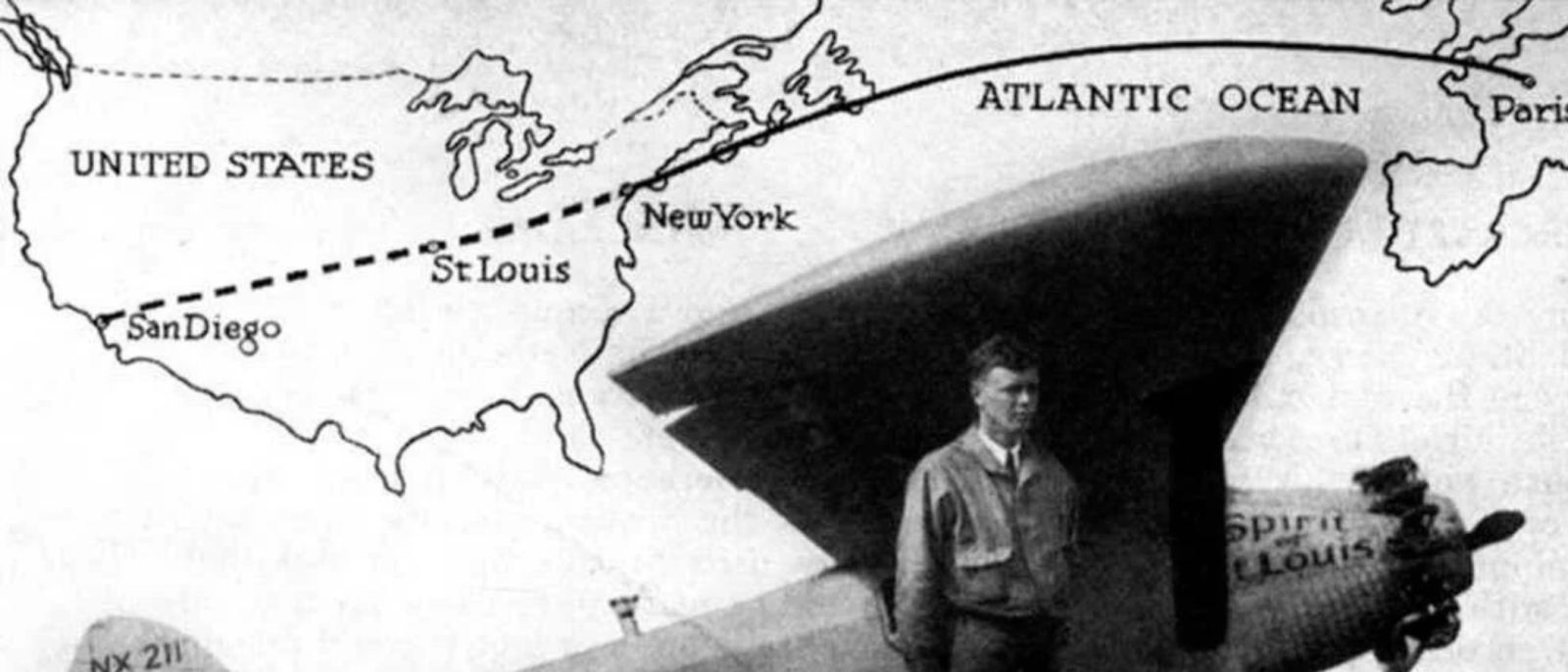
On the morning of 20 May 1927, a twenty-five-year-old airmail pilot named Charles Lindbergh took off from Roosevelt Field on Long Island in a single-engine monoplane, the Spirit of St. Louis. He was competing for the Orteig Prize, a reward of twenty-five thousand dollars offered for the first nonstop flight between New York and Paris. Several famous aviators had tried and failed; some had died in the attempt. Lindbergh flew alone, without a radio, with extra fuel tanks blocking his forward view.
About thirty-three and a half hours later, on the evening of 21 May, he landed at Le Bourget airfield near Paris, where a crowd of tens of thousands was waiting. He became, overnight, the most famous man in the world.
Navigation by reckoning
Lindbergh navigated across the Atlantic mainly by dead reckoning. He calculated his course in advance, held it with his compass and estimated his position from his speed, his heading and the time elapsed. He had no way of fixing his exact position over the open ocean. Wind could push him off course without his knowing it, and fatigue could lead to errors. When he finally sighted the coast of Ireland, he found that he was remarkably close to his intended route. It was a triumph of skill, but also of good fortune.
The problem of the ocean
For aviators who wanted to fly long distances over water, dead reckoning alone was not enough. Ships had long used celestial navigation, measuring the angle of the Sun or stars above the horizon with a sextant and using accurate time to calculate their position. But the methods used at sea were slow and complex. An aircraft moved far faster than a ship, and a pilot or navigator had to work in a cramped, vibrating, cold cockpit. Navigation methods needed to be simplified and speeded up for the air.
A collaboration
After his flight, Lindbergh became deeply interested in aerial navigation. He studied celestial navigation with Philip Van Horn Weems, a United States Navy officer who was one of the leading experts in the subject and who was developing new methods and tables for air navigators. Their collaboration, and their work with the watchmaker Longines, produced two of the most important navigation watches in history.