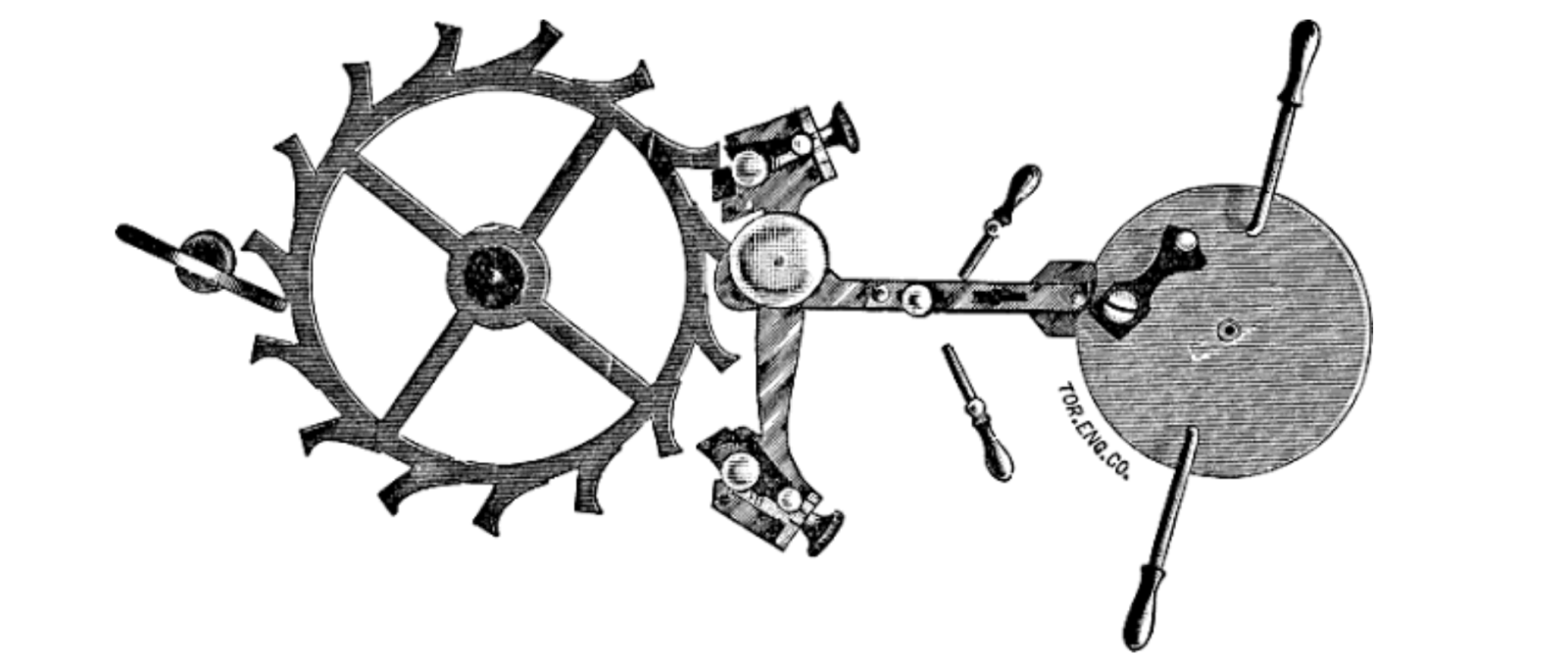
Article · The heart of the watch · c. 1755
The invention that waited a century
Look inside almost any mechanical watch made in the last hundred years and you will find the same small mechanism: a lever, a fork and a toothed wheel. It was invented in London in the 1750s by a man who doubted it would ever be widely used.
What an escapement does
A watch has two halves. One stores energy, the mainspring, and passes it through a train of wheels. The other measures time, the balance swinging back and forth on its spring. Between them sits the escapement, which has two jobs: to let the wheels advance by one small step at each swing of the balance, and to give the balance a little push to keep it moving. It is the link between power and time, and its quality determines much of how well a watch performs.
For the first two centuries of the watch, the escapement was the verge, inherited from medieval tower clocks. In a verge, the balance is never free. The teeth of the crown-shaped escape wheel push constantly against the pallets on the balance staff, so every irregularity in the power reaching the escapement disturbs the balance. Verge watches had to be thick, and they could only be so accurate.
A search for freedom
In the early eighteenth century, the English makers Thomas Tompion and George Graham perfected the cylinder escapement, in which the balance staff carries a hollow half-cylinder and the escape wheel teeth rest against it. The cylinder allowed thinner watches and was a clear improvement, but the balance still rubbed against the escape wheel for most of its swing. Watchmakers dreamed of a detached escapement: one that would leave the balance completely free for most of its oscillation, touching it only briefly to unlock the train and give it impulse.
The man who achieved this in a practical form for watches was Thomas Mudge, a pupil of Graham. His solution, the detached lever escapement, would become the most successful watch mechanism ever devised. But it took the rest of the watchmaking world more than half a century to realize it.
The idea in one sentence
In Mudge’s escapement, a separate lever stands between the escape wheel and the balance. The escape wheel pushes the lever, the lever pushes the balance through a pin, and then the lever is held out of the way while the balance swings freely. The balance only meets the rest of the watch for a tiny fraction of each swing.