Brand · Biel, Switzerland
Omega
Founded in 1848, Omega tied its name to space exploration and the movies.
Louis Brandt opened his workshop in La Chaux-de-Fonds, Switzerland, in 1848. The Omega name came from a movement launched in 1894 that was so successful it ended up naming the company.
The Omega Speedmaster arrived in 1957 as a chronograph for motor racing. NASA tested it and approved it for crewed missions in 1965, and it was on the wrists of the astronauts who walked on the Moon in 1969.
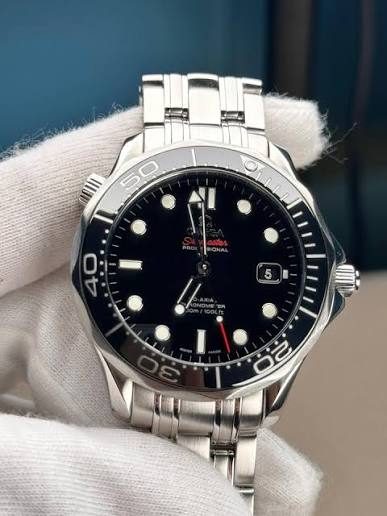
At sea, the Seamaster line has existed since 1948. Its dive version, the Omega Seamaster 300M, launched in 1993, is the main rival to the Rolex Submariner.
Did you know?
Since 1995, James Bond has worn Omega watches on screen, almost always a Seamaster.
Where this brand appears
Omega is mentioned in 25 other entries in this wiki.
- Article 1969: The Race for the Automatic ChronographIn 1969, three rival teams in Switzerland and Japan raced to launch the first self-winding chronograph. All three claim to have won. p. 6
- Article 1972: The Royal Oak and the Luxury Sports WatchA watch sketched overnight, made of steel and priced like gold. Audemars Piguet’s Royal Oak of 1972 created the luxury sports watch. p. 3
- Article Before the Submariner: The First Divers’ WatchesLong before the classic dive watches of 1953, watchmakers, naturalists and naval engineers were taking wristwatches underwater. This is their story. p. 1
- Article Comex and the Helium Escape ValveDivers living for weeks under pressure found that their watch crystals popped off as they decompressed. The cause was helium, and the cure was a tiny valve. p. 2
- Article Fifty Fathoms and the Modern Dive WatchTwo French naval officers wrote a list of what a combat diver’s watch must do. A Swiss executive who dived himself built it, and the modern dive watch was born. p. 8
- Article James Bond and the Watch on ScreenFrom a Submariner in 1962 to a Seamaster in 1995, the watches worn by James Bond reflect sixty years of cinema, gadgets and changing tastes. p. 1
- Model Omega Seamaster 300MOmega's dive watch, with a helium escape valve and a wave-pattern dial. p. 1
- Model Rolex SubmarinerThe most copied dive watch in history, launched by Rolex in 1953. p. 4
- Article Seiko at the Observatory TrialsIn the 1960s Seiko timed the Tokyo Olympics and sent its best movements to the Swiss observatory contests. Within a few years, it was near the top. p. 2
- Article Soviet Watchmaking and Gagarin’s WatchThe Soviet Union bought an entire American watch factory in 1929, built one of the largest watch industries in the world and sent a watch into space in 1961. p. 3
- Article The Accutron and the Tuning-Fork WatchIn 1960, Bulova launched a watch that hummed instead of ticked. Its tiny tuning fork made it the most accurate wristwatch in the world, and it went to space. p. 3
- Article The Dirty DozenIn 1944 the British Army ordered a standard wristwatch from twelve Swiss makers. Collectors later named them the Dirty Dozen and set out to own all twelve. p. 1
- Article The Farmer-Watchmakers of the JuraLong winters, isolated valleys and a legend about a broken English watch: how the Jura mountains became the workshop of the world’s watch industry. p. 4
- Article The Geneva Seal and the Swiss Made LabelTwo small marks, one created by a canton in 1886 and one written into federal law in 1971, that tell the story of how Swiss watchmaking protected its name. p. 4
- Article The History of the Self-Winding WatchFrom Perrelet’s perpétuelles to Harwood’s bumper and Rolex’s rotor: two centuries of trying to make a watch wind itself from the motion of its wearer. p. 5
- Article The Mechanical RenaissanceA forgotten brand bought for a song, a family reunited after the Berlin Wall fell and a few independent craftsmen: how the mechanical watch came back. p. 2
- Article The NASA Tests of 1965In 1965 NASA tortured three chronographs with heat, cold, vacuum and shocks to choose a watch for its astronauts. One survived, and went on to the Moon. p. 1
- Article The Observatory Chronometer TrialsFor a century, the world’s best watchmakers sent their finest movements to astronomical observatories to be tested and ranked. The results made reputations. p. 2
- Article The Oyster and Mercedes GleitzeIn 1926 Rolex patented a truly waterproof case. A year later, a London typist swam with one in the English Channel, and advertising history was made. p. 3
- Article The Quartz CrisisIn December 1969, Seiko sold the first quartz wristwatch. Within fifteen years, the Swiss watch industry had lost two-thirds of its jobs. p. 1
- Article The Swatch and the Swiss RevivalIn 1983, a plastic watch with just 51 parts came out of a Swiss factory and helped rescue an industry that quartz had nearly destroyed. p. 3
- Article The Swiss Watch StatuteHow a crisis in the 1920s and 1930s led Switzerland to organize its watch industry into cartels and permits, and why that system ended in 1971. p. 2
- Article Thomas Mudge and the Lever EscapementThe London watchmaker who invented the lever escapement in the 1750s never saw it adopted. A century later it was inside almost every watch in the world. p. 4
- Article Trench Watches of the Great WarHow the First World War, with its synchronized barrages and night attacks, turned the wristwatch from a lady’s jewel into a man’s essential tool. p. 2
- Article Who Invented the Wristwatch?A queen’s bracelet, a Hungarian countess, naval officers, a Brazilian aviator and a German salesman in London: the many beginnings of the watch on the wrist. p. 3