Article · Complications · 1762–today
A watch that knows the calendar
Thirty days hath September, April, June and November. Most of us need a rhyme to remember. A perpetual calendar remembers by itself, and will show the correct date, without adjustment, for decades.
The problem of the calendar
Our calendar is irregular. Months have thirty-one, thirty, twenty-eight or twenty-nine days, in a pattern that has no simple logic. Every four years, February gains an extra day. And every hundred years, the leap year is skipped, except every four hundred years, when it is kept. This is the Gregorian calendar, introduced by Pope Gregory XIII in 1582 to keep the calendar in step with the seasons.
For a simple watch with a date display, this irregularity is a nuisance. Most date watches simply count to thirty-one and then return to one. At the end of every month with fewer than thirty-one days, the owner must advance the date by hand. That means five corrections a year, more in a leap year cycle.
Levels of memory
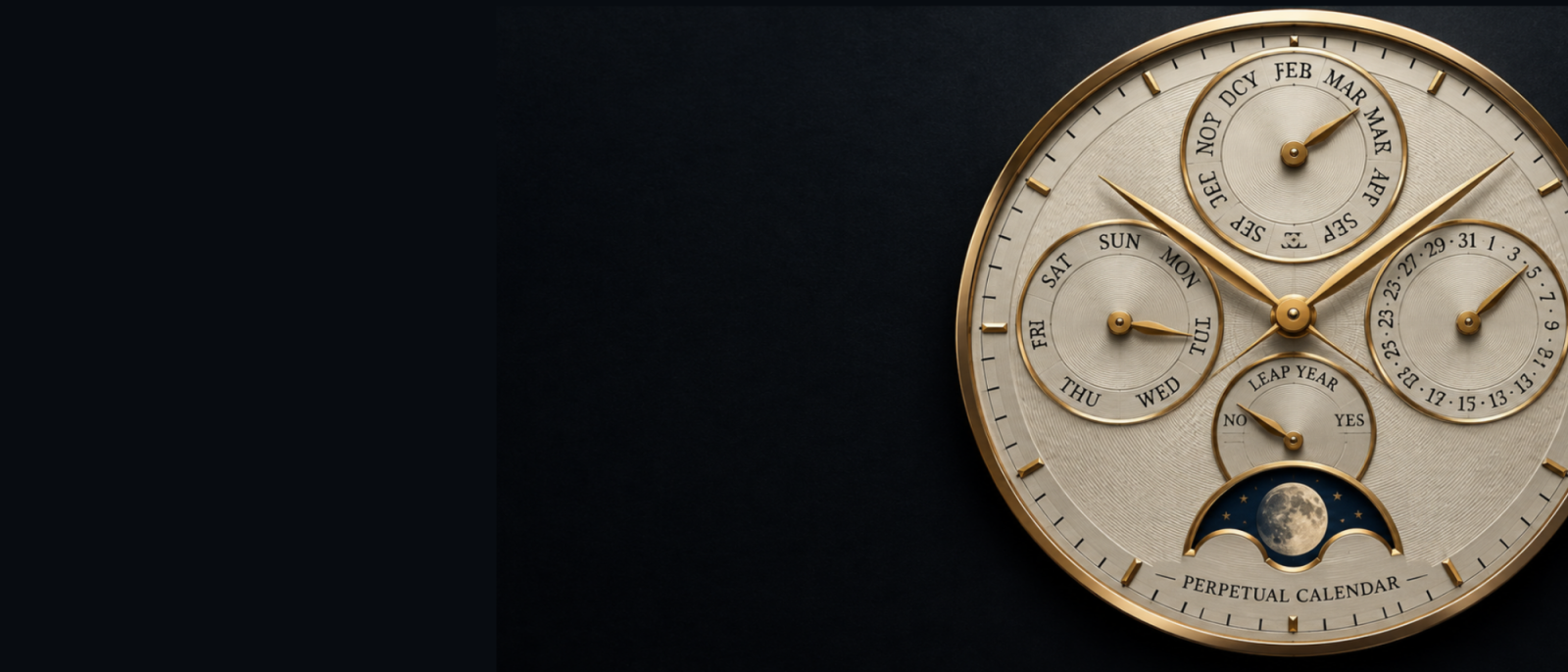
Watchmakers have developed several levels of calendar complication to deal with the problem. A simple calendar shows the date and needs correction at the end of short months. An annual calendar, a more recent invention, knows which months have thirty and which thirty-one days, and needs correction only once a year, at the end of February. A perpetual calendar goes further: it knows the length of every month and recognizes leap years, so that it shows the correct date automatically until the year 2100, when the Gregorian rule skips a leap year that the mechanism does not know about.
A secular perpetual calendar goes further still, taking account of the century rule, so that it remains correct for centuries. Only a few have ever been made.
A mechanical memory
The perpetual calendar is one of the classic grand complications of watchmaking, alongside the minute repeater and the chronograph. It is admired not for speed or sound but for its intelligence. Inside the watch, a set of cams, levers and wheels acts as a mechanical memory, storing the pattern of the calendar and applying it day after day, year after year. To many watch lovers, it is one of the most satisfying complications of all.