Article · Complications · 1680s–today
Time you can hear
Slide a small lever on the side of the case and the watch begins to sing: low notes for the hours, a pair of notes for each quarter, high notes for the minutes. The minute repeater was born to tell time in the dark. It survives because nothing else sounds quite like it.
Darkness and the watch
For most of human history, night was truly dark. Candles and oil lamps were expensive, took time to light and gave poor light. Waking in the night, a person had no easy way to know the time. Public clocks struck the hours, but the sound did not always carry, and between the hours there was nothing. For the wealthy, who could afford a fine watch, this was a problem worth solving.
The solution was the repeating watch, a watch that would strike the time on a bell or gong whenever its owner pressed a button or slid a lever. Placed beside the bed or carried in the pocket, it could tell the time in total darkness. A repeater was a luxury, but it had a clear practical purpose.
From hours to minutes
The earliest repeaters struck only the hours and quarters. A quarter repeater sounded the number of hours, then the number of quarters that had passed. Later, half-quarter repeaters added an extra note for each seven and a half minutes. Five-minute repeaters struck the number of five-minute intervals. The ultimate form, the minute repeater, struck the hours, the quarters and then the number of minutes past the last quarter, giving the exact time to the minute.
How it sounds
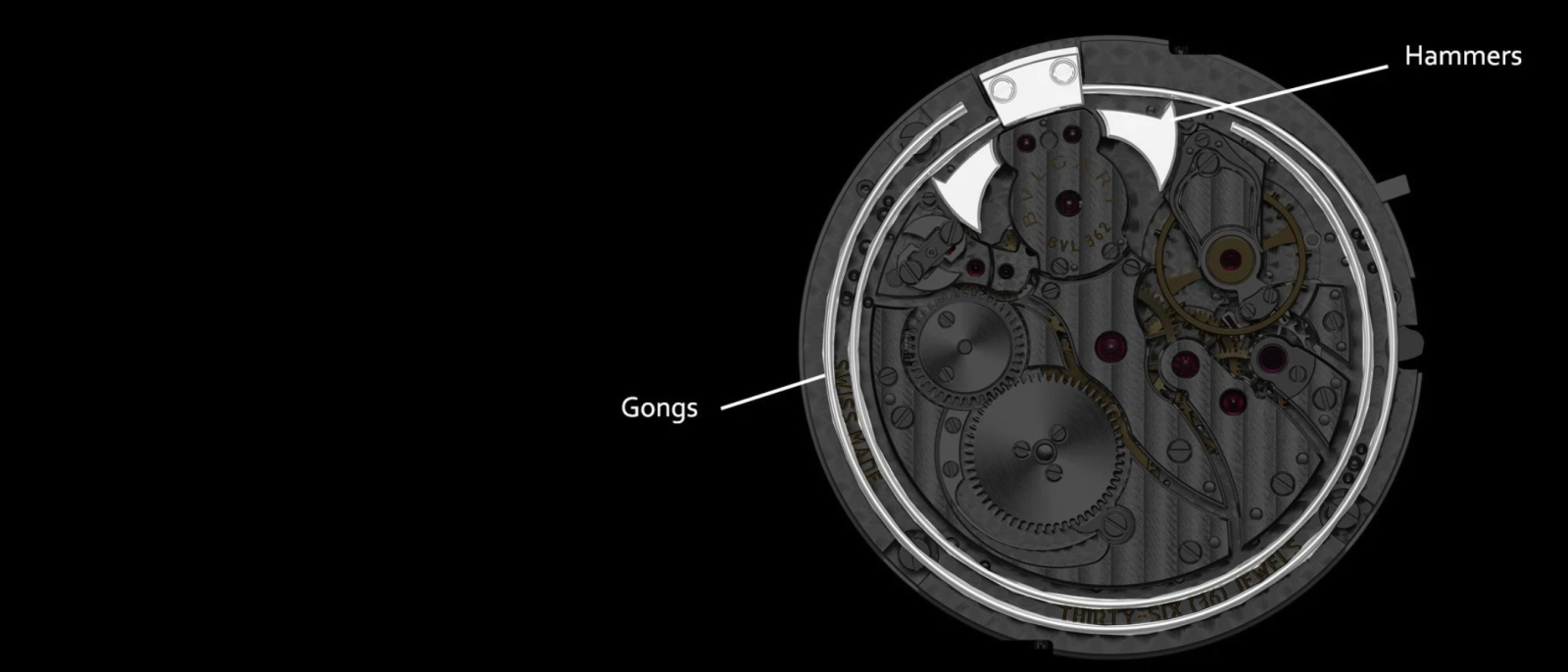
A typical minute repeater has two hammers and two gongs, one low and one high. At, say, twenty-three minutes past ten, the watch strikes ten low notes for the hours. Then it strikes one double note, high and low together or in quick succession, for each quarter that has passed: one quarter in this case. Finally, it strikes eight high notes for the eight minutes since the quarter. The whole sequence takes perhaps fifteen to twenty seconds. A skilled listener can tell the time without counting consciously.
A grand complication
The minute repeater is generally considered one of the most difficult complications to make. Its mechanism must read the position of the hands mechanically, translate it into a series of strikes and deliver them at an even, pleasing pace. It must also produce a beautiful sound, which depends on the gongs, the hammers, the case and countless details of construction. It combines mechanical complexity with something closer to the art of an instrument maker.