Longitude · chapter 6
Five facts about Harrison
- 1He disliked oilHarrison distrusted the lubricants of his day, which thickened and decayed. Much of his genius went into designing mechanisms that needed none.
- 2The bimetallic stripHarrison’s invention for H3, two metals joined so they bend with temperature, is still used in thermostats and electrical devices.
- 3A buried treatiseIn old age, Harrison wrote a strange and difficult treatise that argued, among other things, about the musical scale. It is rarely read.
- 4H4 still existsThe original H4 is kept at the Royal Observatory, Greenwich. It is rarely run today, to protect its mechanism.
- 5Remembered in the AbbeyIn 2006 a memorial to Harrison was unveiled in Westminster Abbey, close to the grave of his friend and supporter George Graham.
Spec sheet
H4 (1759)
- Diameter
- about 13 cm
- Weight
- about 1.45 kg
- Case
- Silver
- Escapement
- Modified verge with diamond pallets
- Special features
- Remontoire, temperature compensation
- Running time
- about 30 hours
- Where today
- Royal Observatory, Greenwich
Why it matters
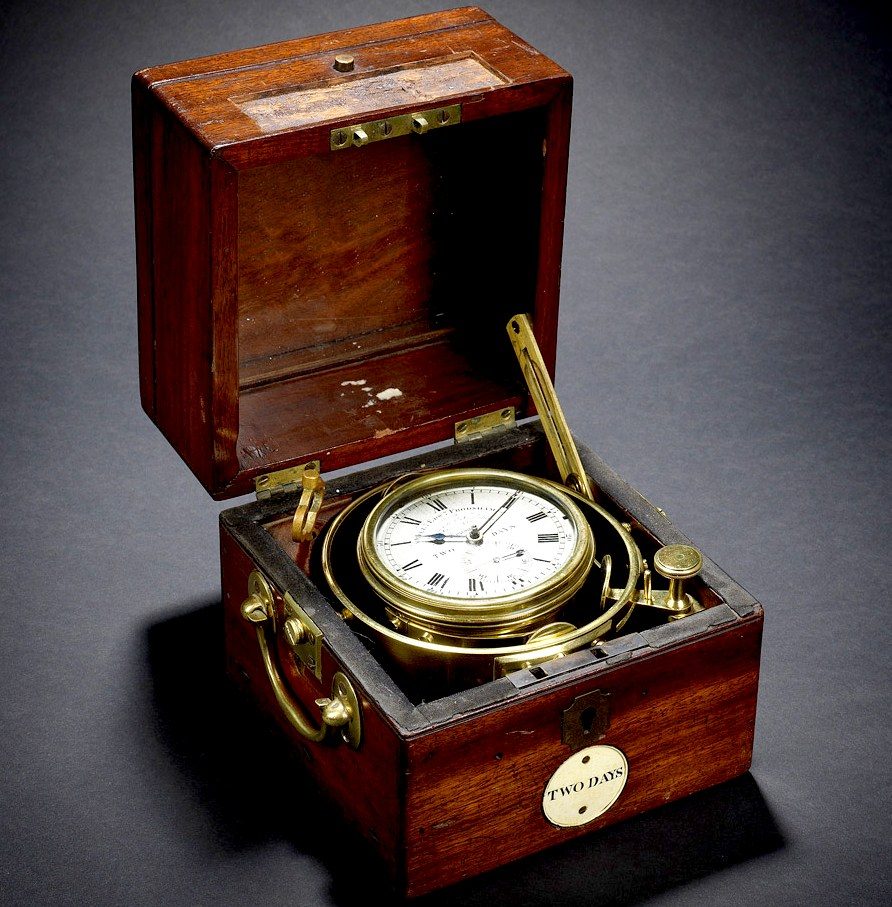
Every time a ship found its way home across an empty ocean, Harrison’s idea was at work.https://www.bluebird-electric.net/bluebird_history/Marine_Chronometer_Invention_Board_Of_Longitude.htm
The marine chronometer made global navigation safer and charts more accurate, and it underpinned the expansion of trade and empire in the nineteenth century. It also changed timekeeping on land. Greenwich became the reference point because British navigators set their chronometers to Greenwich time, and in 1884 an international conference chose the Greenwich meridian as the prime meridian of the world.
For the history of the watch, Harrison’s achievement had another meaning. He proved that a portable mechanical timekeeper could reach a precision that most scientists had thought impossible. Every chronometer certificate, every observatory trial and every modern precision watch carries a trace of that proof.
Sources and further reading
Last reviewed October 10, 2026. Spotted a mistake? Tell us.