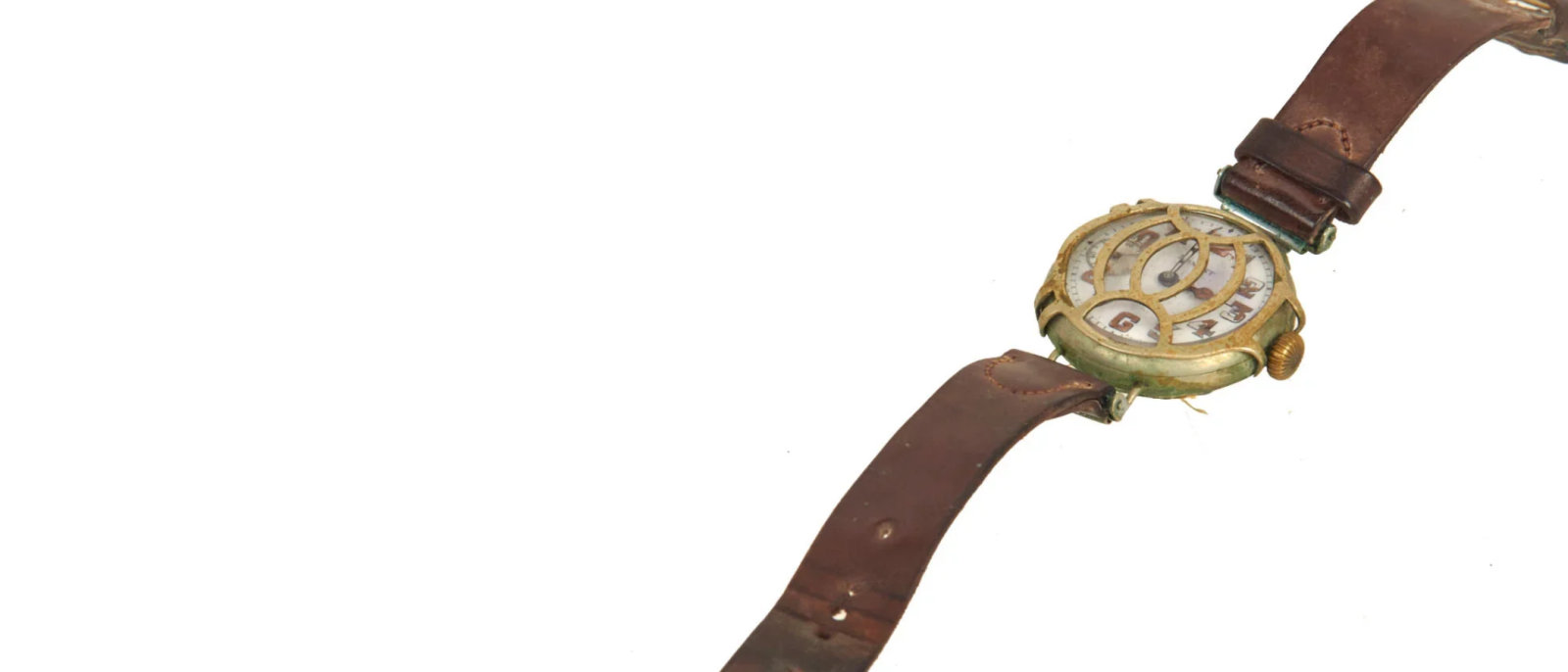
Article · War and the watch · 1914–1918
Zero hour
On the Western Front, attacks were timed to the second, artillery fire moved forward by the clock and officers led their men over the top at a precise minute. The pocket watch could not keep up. The wristwatch could.
A war run by the clock
The First World War was the first great industrial war, and it ran on time. Millions of soldiers faced each other along trench lines stretching from the North Sea to Switzerland. Attacks required the coordination of infantry, artillery, engineers and, later, tanks and aircraft across many kilometers. Since radio was primitive and telephone lines were often cut by shellfire, timing was the main means of coordination. Orders specified the exact minute at which each action should begin.
The most important of these was zero hour, the moment of attack. Before a major assault, officers synchronized their watches, often using a time signal passed down from headquarters. At zero hour, the artillery would lift its fire, mines would be blown and the infantry would climb out of their trenches. A watch that was a minute wrong could send men forward into their own artillery fire, or leave them exposed while the enemy recovered.
The creeping barrage
As the war went on, tactics became even more dependent on time. The creeping barrage, developed in 1915 and 1916, was a curtain of artillery fire that advanced across no man’s land in front of the attacking infantry at a set pace, moving forward perhaps a hundred meters every few minutes. The infantry had to follow close behind, so close that they risked being hit by their own shells, but near enough to reach the enemy trenches before the defenders could emerge. The timetable of the barrage was fixed in advance, and the infantry had to keep to it precisely.
Why the pocket watch failed
In these conditions, a pocket watch was a liability. An officer who needed to check the time while holding a pistol, a whistle, a map or a trench ladder, often in the dark and the rain, could not easily fumble for a watch in his tunic pocket and open its case. A watch on the wrist could be read instantly. The wristlets that some officers had used in earlier colonial wars became a necessity. Within the first years of the war, the wristwatch became standard equipment for officers, and increasingly for other ranks too.
A market transformed
The war created a huge demand for wristwatches. Officers in the British Army were expected to buy their own equipment, and jewelers and outfitters advertised wristwatches as essential kit. Swiss manufacturers, in a neutral country, supplied watches to buyers on both sides of the conflict. American firms joined the market as the United States entered the war in 1917. By the end of the war, the wristwatch had been transformed in the eyes of men from a feminine accessory to a symbol of military service.