Article · Military watches · 1940–1945
Fifty-five millimeters of precision
In the cold, dark fuselage of a bomber, a navigator needed to know the time to the second. The watches built for that job were among the largest and most precise wristwatches ever issued to soldiers.
A different kind of war
The Second World War was the first war in which aircraft played a decisive role. Bombers flew long missions over enemy territory, often at night, and finding the target depended on navigation. The navigators of the period used dead reckoning, radio aids and, especially over the sea or at night, celestial navigation. All of these methods depended on accurate time. A navigator who knew the exact time could calculate his position from the stars or from his speed and heading.
The air forces of all the major powers issued special watches to their navigators. The German Luftwaffe developed one of the most distinctive: the Beobachtungsuhr, or observation watch, usually shortened to B-Uhr. The word observer, in German air force usage, referred to the navigator, who observed and directed the course of the aircraft.
Built to a specification
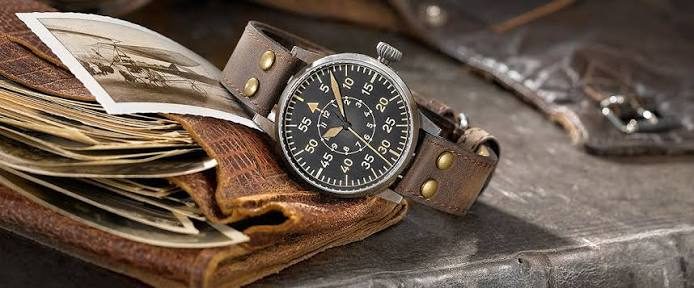
The B-Uhr was built to a precise specification issued by the German air ministry, the Reichsluftfahrtministerium. The ministry defined the size, the dial, the materials and the performance of the watch. Several manufacturers made B-Uhren to this specification, and although their watches differed in details, they shared the same essential design. Each was marked on the case with a military code: FL 23883, a reference number in the Luftwaffe’s equipment system.
Enormous by design
The most striking feature of the B-Uhr was its size. Its case measured fifty-five millimeters in diameter, enormous for a wristwatch, larger than many pocket watches. The size made the dial easy to read in poor light, in a vibrating aircraft, by a man wearing an oxygen mask and goggles. It also allowed the use of a large, precise movement derived from pocket watch designs. The watch was worn on a long leather strap, so that it could be fastened over the sleeve of a thick flying jacket.
Precision demanded
The B-Uhr was not just big. It was required to be highly accurate, to the standard of a chronometer. The movements had to be carefully adjusted and were tested before being accepted by the military. Precision was essential, because navigators relied on their watches for calculations in which a few seconds could make a difference of kilometers.