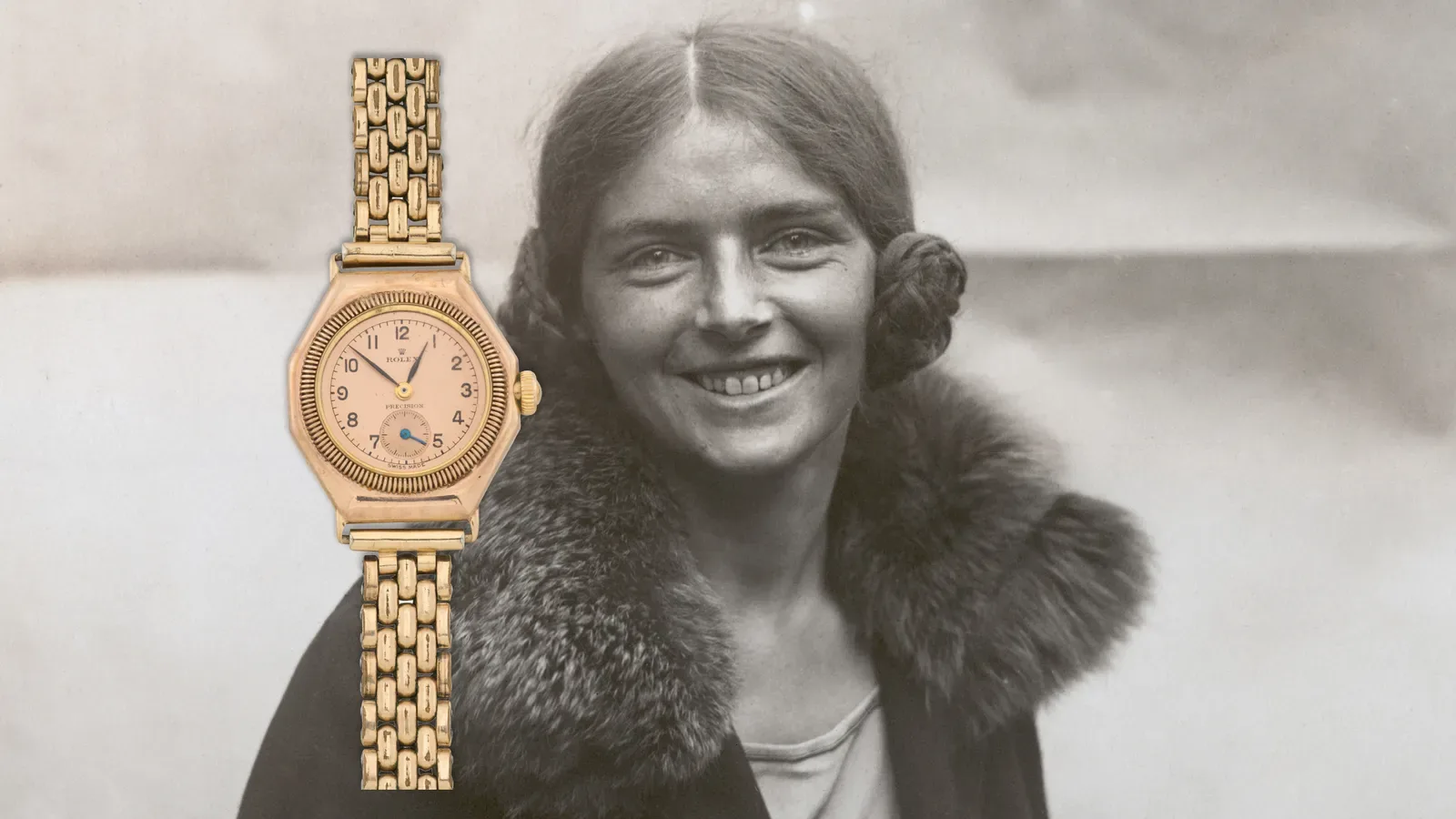
Article · The waterproof watch · 1926–1927
Ten hours in the Channel
In the 1920s, wristwatches were fragile things that feared dust, sweat and water. Hans Wilsdorf believed a watch could be sealed like a submarine. To prove it, he needed a dramatic demonstration, and he found it in a young swimmer from London.
The enemies of the watch
The wristwatch had won its place on men’s wrists during the First World War, but it had a serious weakness. A watch on the wrist is exposed to everything: rain, sweat, washing water, dust and dirt. In the 1920s, most watch cases had simple snap-on backs and bezels, and crowns that let in moisture and grit whenever they were pulled out. Dust and water were the chief enemies of a mechanical movement. They caused rust, clogged the oil and wore out the delicate parts. Many wristwatches spent much of their life in repair shops.
Manufacturers had tried to solve the problem before. Various water-resistant cases had been patented, some with extra covers over the crown or with screw-on parts. A few were sold in small numbers, including watches advertised as waterproof for soldiers and sailors. But none had become a widely accepted standard, and many were bulky or awkward to use.
Wilsdorf’s obsession
Hans Wilsdorf, the founder of Rolex, had built his business on the conviction that the wristwatch would replace the pocket watch. He had already worked to prove that wristwatches could be precise, obtaining chronometer certificates for them. Now he set out to make them robust. Wilsdorf was a brilliant marketer, and he understood that a truly waterproof wristwatch would be not only a technical achievement but a powerful selling point. His company had moved its base to Geneva after the war, and it devoted itself to the problem.
The Oyster
The solution came in 1926. Rolex patented a case in which the bezel and the caseback were screwed down tightly onto the middle of the case, compressing a seal. The weak point, the crown, was addressed by a winding crown that screwed down onto a tube on the side of the case, sealing it like a bottle cap. The screw-down crown system had been patented by two Swiss watchmakers, Paul Perregaux and Georges Perret, and Wilsdorf acquired the rights. Combined, these elements created a case that was hermetically sealed. Wilsdorf named it the Oyster, because, like an oyster, it could stay closed under water.
The Oyster was a breakthrough. It did not look very different from other watches of the time, but it was fundamentally more robust. Rolex registered the design and began producing Oyster watches. Now it needed to convince the public.