Articles · The Dollar WatchWatchShop Wiki · Vol. 2
Dollar watch · chapter 6
Five facts about the dollar watch
- 1
- 2Sold beside the cigarsIngersoll watches were sold in tobacco shops, drugstores and general stores, alongside everyday goods, rather than mainly in jewelry stores.
- 3The Waterbury long windAn earlier Waterbury watch of the 1880s had a mainspring so long that it took a great many turns of the crown to wind it fully, a feature that became a standing joke.
- 4A collectible todayEarly dollar watches, once thrown away when they broke, are now collected, and examples in original condition are increasingly hard to find.
- 5Heir to the traditionTimex, the successor to Waterbury and Ingersoll, kept the mass-market philosophy alive for the rest of the twentieth century.
Spec sheet
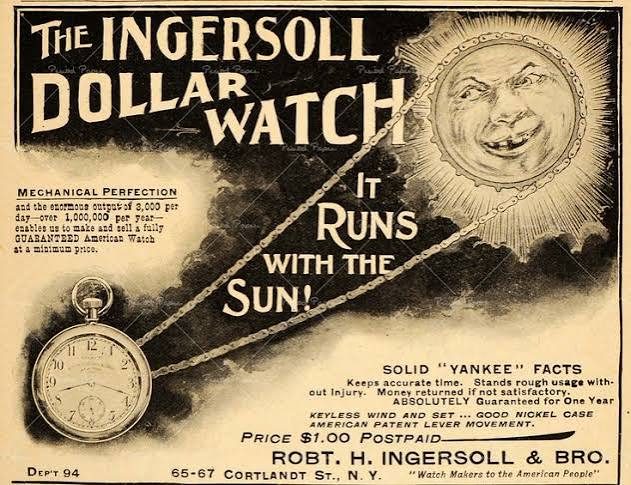
Ingersoll Yankee (c. 1900)
- Price
- One dollar
- Case
- Nickel-plated brass
- Movement
- Stamped brass, pin-lever escapement
- Jewels
- None
- Maker
- Waterbury Clock Company, for Ingersoll
- Sold through
- Mail order and general stores
Why it matters
Fine watchmaking made the watch beautiful. The dollar watch made it universal.
The history of watches is often told through great inventors and luxurious masterpieces. The dollar watch belongs to a different history, one of mass production, advertising and ordinary people. It made the watch a tool of daily life for millions who had never owned one.
That tradition lives on wherever a reliable watch is sold at a low price, from the Timex to the Seiko 5 to the Swatch. Each of them, in its way, continues the work that Roskopf, Waterbury and the Ingersoll brothers began.
Sources and further reading
Last reviewed October 10, 2026. Spotted a mistake? Tell us.
The Dollar Watch · Legacy60